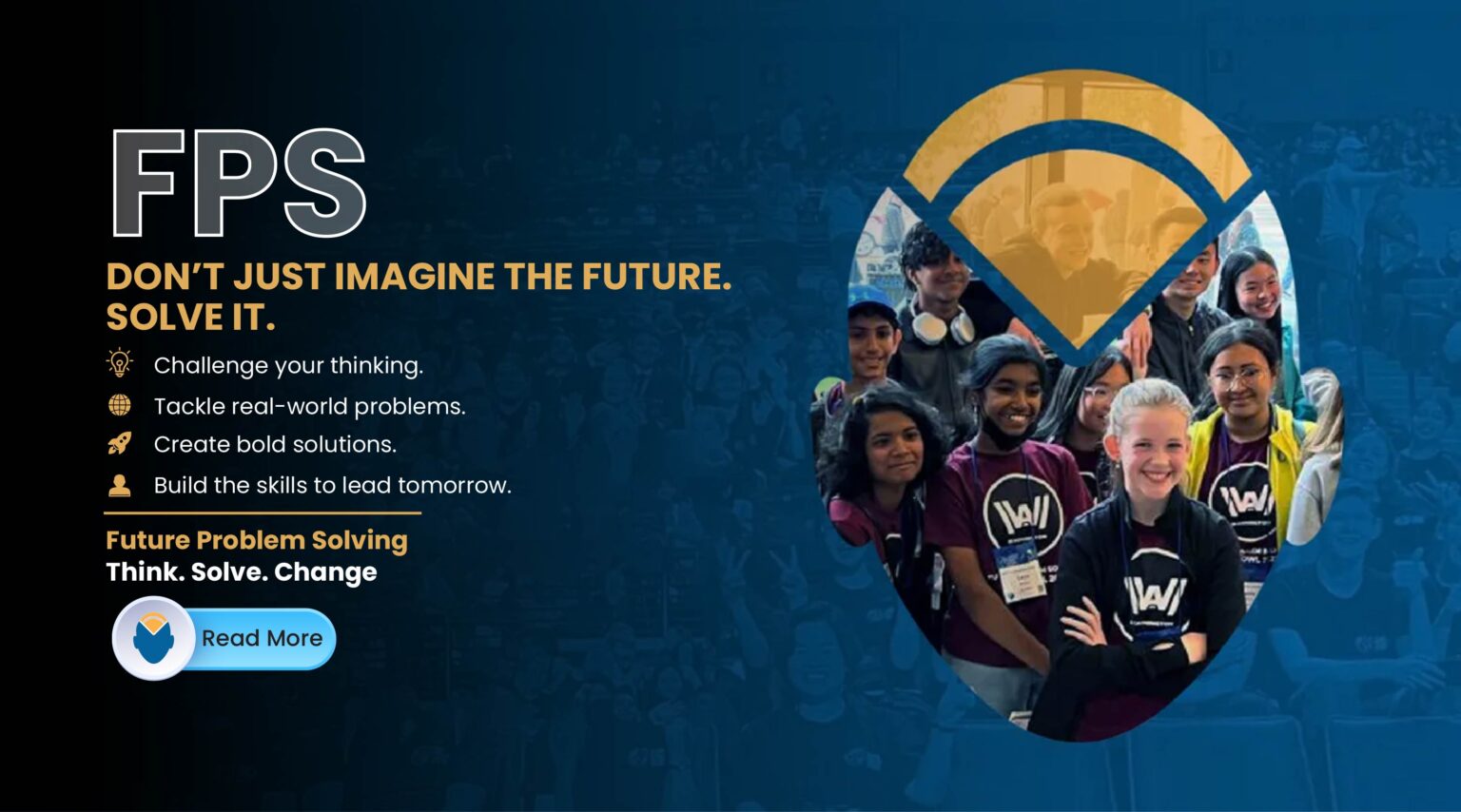
Future Problem Solving (FPS)
Think Beyond Today. Solve for Tomorrow.
Future Problem Solving (FPS) is an international educational program that challenges students to think critically, think creatively, research real-world issues, imagine possible futures, and develop solutions.
Founded in 1974 by creativity pioneer Dr. E. Paul Torrance, Future Problem Solving has spent more than 50 years helping young people become confident problem-solvers and changemakers. Today, more than 30,000 K–12 students participate each year, with students participating across 34+ U.S. states and 14+ countries.
The philosophy is straightforward: students learn how to think, not what to think.
What Is Future Problem Solving?
Future Problem Solving takes students beyond memorization and asks them to apply what they know.
Students research and analyses real-world issues, identify challenges, generate possible solutions, evaluate those solutions, and develop an action plan. The process is built around FPS’s proven six-step problem-solving method and incorporates both divergent and convergent thinking.
The program’s topics draw from important challenges in:
- Business and economics
- Civics and society
- Science
- Technology
Students encounter these issues through hypothetical future scenarios as well as real community problems.
Why Future Problem Solving?
The world students will enter is changing quickly. FPS focuses on developing skills that can be applied across subjects, classrooms, competitions, and real-life situations.
Its approach emphasizes the 5Cs of Learning:
FPS describes these as core values connected to 21st-century learning.
The Six-Step Problem-Solving Method
At the heart of Future Problem Solving is a structured six-step process.
The process is deliberately flexible. FPS explains that students can apply the model to imagined future scenarios or real-world issues of their own choosing.
What Makes FPS Different?
Real-World Issues
FPS topics are built around significant challenges rather than isolated academic exercises. Students explore issues spanning business, civics, society, science, and technology.
Future Thinking
Students are not simply asked what is happening today. They are challenged to consider what could happen next.
Future Scenes are imagined “what if” scenarios based on current topic information. FPS develops these scenarios using research, future projections, expert review, and subject-matter expertise.
Authentic Assessment
There is not necessarily one “right” answer.
FPS uses rubric-based assessment and trained evaluators to provide learner-focused feedback on students’ work. Evaluations consider the different stages of the problem-solving process and are designed to help students strengthen their skills.
Competition and Collaboration
FPS offers educational experiences for both individual students and teams up to four students, with competitions taking place at local, regional, affiliate, and international levels.
Who Can Participate?
Future Problem Solving serves K–12 students.
The competition programs use three divisions:
- Junior: Grades 4–6
- Middle: Grades 7–9
- Senior: Grades 10–12
FPS Programs
Future Problem Solving currently offers two main competition programs, classroom learning resources and Challenges in Pakistan:
1. Global Issues
Global Issues is designed for students who enjoy research, current issues, future thinking, and problem solving.
Students research real-world topics and then apply the six-step process to an imagined future situation. Students can compete individually or in teams of up to four.
Each school year, students work through practice and qualifying problems, with successful participants progressing through regional affiliate competition toward the International Conference.
For the 2026–2027 Northern Hemisphere season, the topics listed by FPS are:
- Digital Dark Age
- Disappearing Cultures
- Influencer Marketing
- Health Security
2. Creative Writing
Creative Writing gives students an opportunity to combine research, future thinking, and storytelling.
Students choose one of the annual competition topics and write an original short story imagining a logical outcome of actions or events at least 20 years in the future.
The competition has three divisions:
- Junior: Grades 4–6
- Middle: Grades 7–9
- Senior: Grades 10–12
It is an individual event, and students write a story of 1,500 words or fewer.
Students are expected to research the selected real-world topic and use that research to inform their futuristic narrative. Their work receives rubric-based feedback from trained evaluators.
At the International Conference, qualifying students receive a new topic-related Future Scene and write a shorter story under a specified time limit.
How Does Competition Work?
For Global Issues, students begin by researching the annual topics and completing practice and qualifying problems. Those who qualify through their regional affiliate can progress to the affiliate finals and potentially to the International Conference.
For Creative Writing, students submit their original work through their regional affiliate. Regional affiliate champions are invited to compete at the International Conference.
The International Conference
The International Conference (IC) is FPS’s highest level of competition.
It brings together 2,000+ champion problem solvers and supporters from around the world. The current FPSPI site reports participation from 14+ countries and 34+ U.S. states, and states that approximately 7% of students qualify for the International Conference.
The conference provides students with an opportunity to compete alongside other high-performing problem solvers while becoming part of FPS’s global community.
The 2027 International Conference is scheduled for June 9–13, 2027, at Indiana University in Bloomington, Indiana.
What Topics Do Students Explore?
FPS deliberately chooses topics that connect students with important real-world challenges.
The current Topics are:
- Digital Dark Age
- Disappearing Cultures
- Influencer Marketing
- Health Security
The questions are deliberately future-focused. Students are asked to consider not only the problem itself, but how it could evolve and what solutions might be possible.
Does FPS Have Evidence of Impact?
FPSPI publishes research and evaluation findings on its website.
Its current impact page reports:
FPS also reports findings from several studies and evaluations. For example, a 2011 University of Virginia alumni study found that 93% or more of surveyed alumni rated Future Problem Solving as important or extremely important in developing skills including critical thinking, teamwork and collaboration, identifying and solving problems, and time management.
A 2017 study reported significantly higher problem-solving performance for students receiving enhanced group training focused on problem-solving style.
FPS also reports a five-year study in which participating students performed significantly higher on the Minnesota Comprehensive Assessment in mathematics and reading. These findings are reported by FPSPI; they should not be interpreted as proof that FPS participation alone caused the differences.
For Community Projects, a 2024 Social Return on Investment analysis reported $4.9 million in social value and an SROI ratio of $1:$33.09. FPSPI notes that student gains accounted for almost 80% of the social impact identified in that analysis.
Is Future Problem Solving Right for You?
FPS could be a strong fit if you enjoy:
- Asking “What if?”
- Researching complex issues
- Coming up with unusual ideas
- Thinking about the future
- Writing or storytelling
- Working with a team
- Finding solutions to difficult problems
- Turning ideas into action
- Communicating your thinking
The program is particularly distinctive because it does not stop at identifying a problem. Students are taught a repeatable process for moving from problem → ideas → evaluation → action.
The Bottom Line
Future Problem Solving is more than a traditional academic competition.
It gives students a framework for researching real-world problems, thinking creatively, evaluating possibilities, imagining the future, communicating ideas, collaborating with others, and developing actionable solutions.
For a student looking beyond conventional competitions, FPS offers multiple pathways—from Global Issues and Creative Writing to Community Projects, Storytelling, classroom Learning, and Challenges.
Think critically. Imagine boldly. Solve creatively. Shape the future.
Competitive Problems
Influencer Marketing – Qualifying Problem Health Security – Affiliate Finals ProblemNote: World Finals 2027: Topic announced March 1, 2027.
Age Criteria:
Eligible grades for Future Problem Solving:
| Division | Grades | Approximate Ages |
|---|---|---|
| Junior | Grades 4–6 | Not specified by FPSPI |
| Middle | Grades 7–9 | Not specified by FPSPI |
| Senior | Grades 10–12 | Not specified by FPSPI |
Note: Future Problem Solving's current program information defines its competition divisions by grade level. FPSPI does not currently publish approximate ages for the Junior, Middle, and Senior divisions on its Global Issues page.
Global Issues:
The Global Issues program uses imagined “what if” future scenarios to explore real-world problems that need to be solved. Students research and analyse each annual topic, then apply Future Problem Solving’s six-step problem-solving process to develop an action plan.
Students begin with two practice problems, followed by a Qualifying Problem. Students who qualify through their regional affiliate complete an additional Affiliate Finals Problem, with regional affiliate champions eligible to advance to the International Conference. A fifth problem topic is announced for the World Finals.
Registered students receive rubric-based feedback from trained evaluators on their submissions, with feedback provided throughout the problem-solving process to help strengthen their skills.
Global Issues is available in Junior (Grades 4–6), Middle (Grades 7–9), and Senior (Grades 10–12) divisions. Students may participate individually or in teams of up to four.
Creative Writing:
The Creative Writing program gives students the opportunity to research a real-world issue and transform their understanding of it into an original futuristic short story.
Students choose one of the four annual problem topics and write an original story imagining the logical outcome of actions or events set at least 20 years in the future. Entries are limited to 1,500 words.
Creative Writing is an individual competition with Junior (Grades 4–6), Middle (Grades 7–9), and Senior (Grades 10–12) divisions. Students receive rubric-based feedback from trained evaluators on their competitive submissions.
Regional affiliates may use either a one- or two-submission format. Where two submissions are offered, the first may be non-competitive and provide written feedback to help students improve their story. Regional affiliate champions are invited to the International Conference.
At the International Conference, students receive a new topic-related Future Scene and may write up to 1,000 words within a specified time limit.
Creative Writing Fee
- Premium Registration Fee (with draft feedback): US$80
- Regular Registration Fee: US$60
Global Issues Problem Solving Fee
- Team Registration: US$ 160 per team
- Individual Registration: US$130 per individual
Coach Fee
- New Coach: US$50
- Returning Coach: US$40
Note:
- All the prices are inclusive of taxes.
- In order to confirm your registration, please fill out the form by clicking on (Register Now) in the tab below.
- You will receive a confirmation email within 24 hours.
- Payment is nonrefundable if you are unable to participate in the competition after registration.
Global Issues Problem Solving (GIPS)
| Submission | Register By | Due Date | Notes |
|---|---|---|---|
| Practice Problem 1 | October 8, 2026 | October 15, 2026 | Practice Problem 1 booklet due. |
| Practice Problem 2 | December 3, 2026 | December 10, 2026 | Practice Problem 2 booklet due. |
| Qualifying Problem | January 28, 2027 | February 4, 2027 | Qualifying Problem booklet due. |
| Affiliate Problem | N/A | March 11, 2027 | Affiliate Problem booklet due for students advancing to this stage. |
Additional Important Dates
- March 1, 2027: International Conference topic announced and registration packet preview.
- May 1, 2027: International Conference registration and payment deadline.
- June 9–13, 2027: International Conference — location TBA.
Important: All dates listed are the final deadlines for student work. Early registration and work submissions are welcome. Feedback on submissions is typically available within 10–14 days after submission.
Creative Writing (CW)
- Premium Registration Deadline: December 3, 2026
- Standard Registration Deadline: February 18, 2027
| Submission | Due Date | Notes |
|---|---|---|
| Draft | December 10, 2026 | Draft due for premium registrations only. Premium registration includes draft feedback. |
| Final Written Submission | March 4, 2027 | Final written submission due. |
Important
- March 1, 2027: International Conference topic announced and registration packet preview.
- May 1, 2027: International Conference registration and payment deadline.
- June 9–13, 2027: International Conference — location TBA.
- All dates are 11:59 PM ET.
- Early registration and work submissions are welcome.
- Feedback on submissions is typically available within 10–14 days after submission.
Results & Feedback: Student submissions are evaluated, and feedback is typically available within 10–14 days after submission.
For the final competition submissions in March, registered students may be eligible to earn an invitation to participate in the International Conference World Finals, June 9–13, 2027.
International Conference Qualification
Students who perform strongly in the final competition submissions in March may earn an invitation to participate in the Future Problem Solving International Conference World Finals, taking place June 9–13, 2027.
GET STARTED
Register Now